5 Year Facility Plan
Bond Information
Frequently Asked Questions
PROJECT PHASES INFORMATION
What is included in each Phase?
Phase #1 Project List:
Staff Restrooms & Lounge Renovation (HS)
South Gym Floor Replacement (HS)
Baseball Field Renovation (HS & East Diamond)
Softball Concessions /Restrooms /Press Box Renovation
Family & Consumer Science Classroom Renovation (HS)
Student Restroom Renovation (ES)
Playground Safe Surface Updates (ES & MS)
North Gym Restrooms Renovation (MS)
Phase #2 Project List:
MS Fine Arts Wing
MS STEM Classroom
MS ADA Accessibility Improvements
MS Activity Room
Wrestling, P.E., etc.
Athletic Performance Center
Practice Gym / Multipurpose Court
Repurpose Current Weight Room
HS Locker Room Shower Renovations
Phase #3 Project List:
HS Fine Arts Wing
HS CTE Upgrades
HS Parking / Access
When will each Phase begin and be completed?
Phase #1 has already seen some initial steps taken by the Board, as it remains a set of S.A.V.E. projects the board has been looking into over the last several months. Next steps with Phase #1 will begin after a public hearing is held after the July 13th, 2026 regular Board meeting. Design efforts will continue for the baseball complex and will begin immediately for other projects. Next a competitive bidding process will be held late in the fall of 2026. Once bids are accepted, this will allow construction on a number of Phase #1 projects to begin the spring/summer of 2027 and be completed in the following months.
Phase #2 will be dependent on the outcome of the general obligation bond to be held on November 2nd, 2027. If passed, the design efforts and competitive bidding process will be completed as soon as possible for Phase #2 projects and we would look to begin construction in the spring/summer of 2028.
Phase #3’s timeline will continue to evolve as Phases #1 and #2 are being completed. The district will pay off another set of S.A.V.E. bonds in 2030, however due to recent legislation school districts in Iowa will be losing 25% of our S.A.V.E. funds each year beginning next year. This significantly impacts how Phase #3 can be funded. Therefore, the district will look to utilize the S.A.V.E. funds available (estimated $3-4 million) and work with the community on another G.O. bond ($4-5 million) to help fund Phase #3. The goal would be to have Phase #3 out to vote in November of 2034, under construction the summer of 2035 and completed in 2036 to complete our 10 year plan. See Roadmap Graphic.
Why are these Phases important right now?
The district has been developing and implementing a long-term facility plan for many years. (See Graphic). The projects on Phase #1 have been the next set of projects documented in that plan. However, next steps in planning were needed, so this year the Board and district leadership team have begun mapping out the next 10-20 years of planning in more detail. As part of that process a list of district infrastructure needs was compiled and reviewed by the Board and district leadership team. Our next steps in prioritizing our infrastructure needs is to engage with the community on a larger level to provide information, take questions, and gather feedback so final decisions on our facility plans can be made.
Furthermore, by investing in our infrastructure now we are able to commit to a significant investment into our current MS and HS campuses. By securing a general obligation bond, it frees up district S.A.V.E and PPEL funds to combat the costs to maintain and update our MS and HS campuses.
To put it in perspective, it’s like an average person trying to save enough cash to buy a house outright rather than using a mortgage; while theoretically possible, the rising costs and time requirements make it practically unfeasible.
How did you prioritize what is included in each Phase?
Several factors are taken into account when prioritizing infrastructure projects. Beginning with safety and security, accessibility and overall conditions of our facilities; we also balance educational needs, student and community experiences, as well as financial stewardship. If projects have significant safety, security, and accessibility concerns they are prioritized as those projects have essential student, staff, and community needs at stake.
Some examples of why certain projects were included in our phases:
Accessibility:
The high school baseball complex is not fully handicapped accessible. Phase #1’s baseball complex renovation would include handicap accessibility improvements.
The wing of the building where the middle school art, wrestling room, and stage are not ADA compliant. This would be an important set of improvements during Phase #2.
The historic south gym at the high school has never been completely handicap accessible. This would also be an important improvement during Phase #2
Safety:
Our baseball diamond lacks appropriate fencing along our backstop and baselines to shield fans and the surrounding homes from foul balls. This issue is further complicated by the location of our field, which is flanked by a busy city street, adding to the safety concerns.
Our current weight room sits on an old stage in which the flooring has been reinforced three times. The current square footage of the room (2,100 sq. feet) does not meet the needs of our student-athletes, as it creates a cramped atmosphere as well as logistical issues with scheduling for both our physical education classes and athletic teams. This is not a long term solution for a safe and functional weight room facility.
Also, Phase #2 allows us to update the southwest entrance to the high school to make it more safe and secure for the high volume of use we see in that part of the building.
Student and Community Experience:
We do not currently have any CTE and/or STEM related facilities in our middle school. With a growing focus on work-based learning and hands-on experience for students with technology, trades, etc. it is important that we grow these programs in our middle school curriculum. Phase #2 would add a STEM makerspace component to our middle school building.
Our middle school band and choir rooms are not big enough to fit our entire ensembles. Phase #2 would address space issues in this wing of the middle school.
We take pride in sharing our facilities with our community, and would like to expand those opportunities. The auxiliary gym in Phase #2 will address a growing need for gym space with our youth through high school level teams. It will significantly cut down on late night practice times for our youth as well as providing a flexible activity space for the community to use.
Through substantial discussion and an overview of district needs and historical data regarding infrastructure investments the Board and district leadership team compiled a comprehensive list of building needs. Using the aforementioned factors as our guide, we are excited to share the drafts of Phases 1, 2, & 3 with our community. See Project Prioritization Graphic.
Why prioritize baseball in Phase 1?
Looking at the big picture, the district has been working for 20+ years now to update athletic facilities:
HS North Gym (2006)
Multipurpose Gym at the MS (2007)
MS North Gym Renovation (2016)
HS South Gym Roof (2017)
Bill Hennessey Field (Softball, 2016-Current)
Scoreboard, bleachers, dugout, playing surface included on Phase #1
Kerry Van Winkle Field (2024)
Dallas Kray Track (2024)
Baseball is the next athletic complex on our list, and it needs our immediate attention.
Our current baseball field and surrounding structures have served us well for over 30 years, but like anything, in time updates are necessary. Our maintenance efforts to sustain the playing surface as well as surrounding buildings has been consistent and effective. However, the press box, restrooms, dugouts, fencing, and storage buildings have become worn down and are in need of substantial updates.
Improving the fan experience at our baseball games is also imperative. In order to provide an improved fan experience, similar to what we have experienced at the football/track complex, we need improved concessions stands, restrooms, seating/standing areas, and improved fencing/netting protection for fans.
Furthermore the safety of our fans can be improved by a better viewing experience with a substantial upgrade to our backstop to a net system that only reduces the number of foul balls, but provides for improved sight lines and removes fans from the access road to structured bleacher seating and standing room areas.
What is wrong with the baseball complex?
This isn't just an historic ballpark; it's a facility that is simply reaching the end of its usable life. The dugouts, built decades ago, are undersized, damp wooden bunkers. The chain-link backstop is bowed and rusted from years of battling the elements and absorbing foul tips; it has been welded together over the years to stay functional. The backstop also lacks the appropriate height for the location of our complex and safety of our fans.
From a planning perspective, continuing to address maintenance needs on a piece-by-piece basis presents a growing financial challenge due to cumulative lifecycle costs. Each spring, the district invests significant time and resources into essential yet temporary fixes, including managing ongoing drainage issues, repairing worn bleacher frames and fencing, and securing structural elements of the dugouts and storage areas. While these efforts keep the facility operational for the season, they function more as short-term adjustments rather than permanent solutions for an aging complex. Delaying a comprehensive renovation means the district will likely face escalating emergency maintenance costs, which resolve immediate issues but do not fundamentally extend the lifespan or quality of the facility.
Most pressing, however, are the safety and accessibility deficiencies that put the district in a critical position. The restrooms are undersized, outdated, and in critical need of updates. The concession stand lacks appropriate space for volunteer work and falls short of the basic necessities to run a fully functional concession stand.
There is no paved, ADA-compliant pathway from the parking lot to the seating area. Spectators with accessibility concerns are forced to navigate uneven grass and gravel slopes just to find a reasonable place to watch the games.
The protective fencing behind the plate and down the lines is too low to shield fans from foul balls. This facility doesn’t just need an aesthetic upgrade; it needs a fundamental overhaul to ensure that every player, coach, and spectator can experience a game with improved amenities and safe infrastructure.
Why does a baseball field cost so much?
Simply put, the cost of materials and construction contracting continue to be on the high end, the architectural costs and renovation considerations, and investing funds into East Diamond also contribute to overall costs. Although we are seeing some more competitive bids with our recent projects (i.e. Elementary Roof and HS Fire Alarm System), we are still dealing with higher construction costs than what we are accustomed to. Unfortunately, this has become the norm, and school districts are having to adjust to this reality.
This is also a comprehensive project to renovate the entire complex, invest in both fields, and upgrade almost everything except the playing surface itself. Thanks to the dedication of Coach Hill, his staff, and our student-athletes, meticulous attention has been given to the playing surface. We have one of the most impressive playing fields in the area, so we will not need to invest in a new grass or turf infield or outfield.
During our design efforts we have scaled this project down to the current costs by reducing the scope of the project from the original design. We began with eliminating some amenities, reducing the size of some of the facilities needed, and looking at potential fundraising opportunities to furnish various aspects of the project.
We firmly believe that we are proposing a renovation that serves our goal to provide an improved fan and player experience for our student-athletes and community but does not include excess costs or amenities. An investment now will provide us with a baseball complex that will last us for several decades.
How much does each Phase cost and how will we pay for it?
Phase #1 is projected to cost approximately $6,000,000. The district will use S.A.V.E. funding.
Phase #2 is projected to cost approximately $12,000,000, which the district will use funds gained if the G.O. bond in 2027 is successful.
Phase #3 is projected to cost between $6,000,000-$7,000,000, which the district will use S.A.V.E funds, and the possibility of a G.O. bond and PPEL funds if needed.
FINANCIAL INFORMATION
How will this bond hold a deeper meaning for future generations?
While the economic pressures of inflation and household budgeting are a real and constant balancing act, we must recognize that the future of every community within the Roland-Story district is inextricably linked to the quality of our schools.
The reality is nowadays more and more families vote with their feet. They choose where to plant roots based on the environment and opportunities provided for their children. Within a 45-mile radius, several neighboring districts offer modern infrastructure, flexible learning spaces designed for today’s students, and robust corporate partnerships that provide access to cutting-edge equipment and professional training.
To remain competitive and ensure our communities thrive, we must provide a learning environment that doesn't just keep pace, but inspires families to choose Roland-Story as their home.
What is S.A.V.E.? PPEL?
S.A.V.E. stands for Secure an Advanced Vision for Education fund, also known as the statewide one-cent sales tax for school infrastructure. PPEL refers to the Physical Plant and Equipment Levy. It is a voter-approved property tax used by public school districts to fund infrastructure, major equipment, technology, and transportation.
Didn't we just do a major G.O. Bond?
The last two G.O. bonds passed in Roland-Story were in 2018 and 2023. In 2018 the community approved a G.O. bond for $9,000,000 to completely renovate the elementary building as well as critical HVAC improvements at the MS and HS. In 2023 the district combined S.A.V.E. funds with a community approved G.O. bond of $3,800,000 to complete Kerry Van Winkle Field and Dallas Kray Track. Both of these bonds are set to be paid off in 2033 when the district would like to target Phase #3, which is important timing in order to help reduce the impact on property tax.
How will Phase #1 be funded?
The district plans to utilize our bonding capacity with our S.A.V.E. funds, also known as the statewide one-cent sales tax for school infrastructure. The district is paying off a substantial amount of S.A.V.E. debt in June, so we have the capacity to invest in the next set of projects. This also means Phase #1 will not impact property tax, as S.A.V.E. funds do not carry property tax implications.
Why not bond against the Physical Plant Equipment Levy?
While some funds will be allocated from these sources for these projects, the voter-approved PPEL levy will be coming to voters for approval on September 8th, 2026. Until that vote is held, the district is limited in the amount of PPEL funds available. The district is hopeful the PPEL levy will be renewed for another 10 years, allowing important building maintenance projects to continue. PPEL and Sales Tax funds are also used to purchase school buses, student and staff computers, and to repair existing equipment.
Could the $6 Million S.A.V.E. money be used to fund other projects? Such as MS/HS Fine Arts updates and/or a new athletic performance center?
Not without removing all of the other projects on the Phase #1 S.A.V.E. list. For instance, renovating the MS and adding the STEM classroom and Activity/Wrestling room is estimated to cost between $5-6 million. The Athletic Performance Center and auxiliary gym is also estimated to cost between $6-7 million. S.A.V.E funds can be used for these projects as well, however we have prioritized the Phase #1 project list at this time. Phases #2 and #3 will have components to utilize future S.A.V.E. funds. We feel like the phases work together in the most effective and efficient way for us to fulfill this set of important infrastructure updates.
If we “pay as we go,” when would the upgrades needed meet today’s standards?
Realistically, several of these projects are unlikely to materialize without the passing of the general obligation bond that we have proposed for Phase #2, especially given Iowa's current economic and political climate regarding educational funding. The success of this plan depends entirely on the passage of the general obligation bond proposed for Phase #2 that will be on the ballot in November of 2027.
Even if we set the political/economic hurdles aside, it would take at least 20 years of dedicated saving just to cover the base costs, assuming we ignore inflation and the myriad of other infrastructure expenses that would arise in the meantime.
Furthermore, by investing in our infrastructure now we are able to commit to a significant investment into our current MS and HS campuses. By securing a general obligation bond in Phase #2, it frees up district’s S.A.V.E and PPEL funds to combat the costs to maintain and continue to update our MS and HS campuses.
How is using General Fund money for Roland-Story compared to other communities?
Roland-Story has strategically utilized surpluses from the General Fund, which is legally restricted from being used for capital projects, to proactively buy down our current levy rates. Rather than directing these resources toward non-essential extras, we prioritize using General Fund dollars to provide direct tax relief to our community, helping to offset the costs associated with necessary capital improvements.
Through years of disciplined fiscal management, Roland-Story has built a sustainable reserve. Each year, once specific financial criteria are met, the Board votes to determine the annual tax reduction.
Why does this matter?
To put the impact into perspective:
Allocating $100,000 from the General Fund can reduce the taxpayer levy by approximately $0.25.
While these funds are a powerful tool for immediate relief, it is important to note that they cannot accumulate quickly enough to replace the need for traditional capital funding. Instead, they serve as a vital "buy-down" mechanism to ensure our district remains fiscally responsible and supportive of our local taxpayers. See Funding Buckets Graphic.
If the bond issue passes, how will it affect my property taxes?
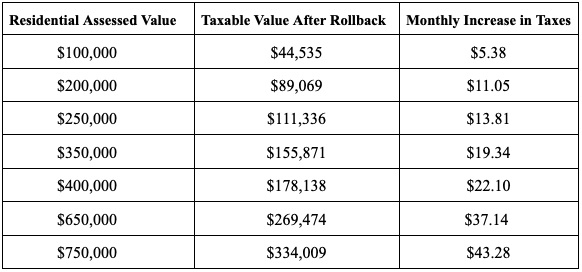
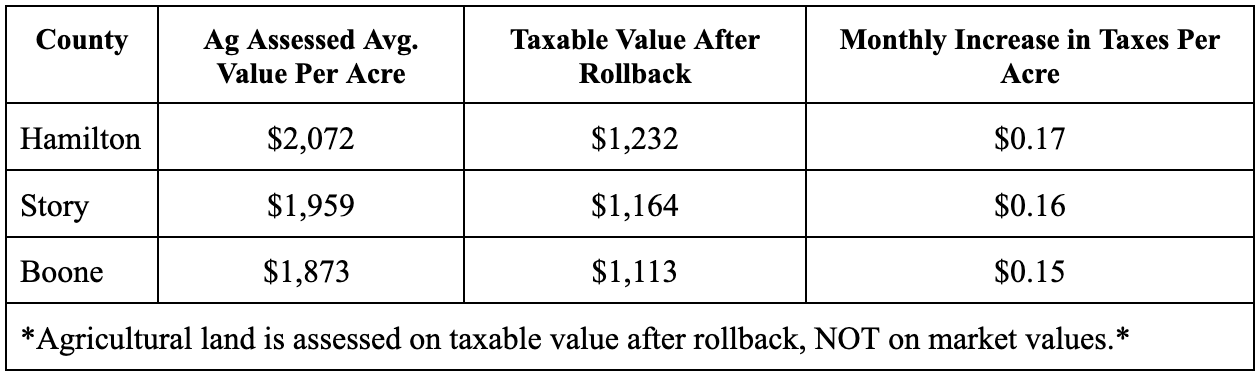
If the bond passes the district’s overall tax rate will increase by $1.65. Individual property owners will be impacted based on the assessed valuation of the property they own. Also, keeping in mind that after rollback rates are issued properties take on a new taxable value which can be found in the tables below.
How does the district's levy rate compare to others?
Our tax rates are comparatively low, and will continue to be competitive in the region even after this bond.
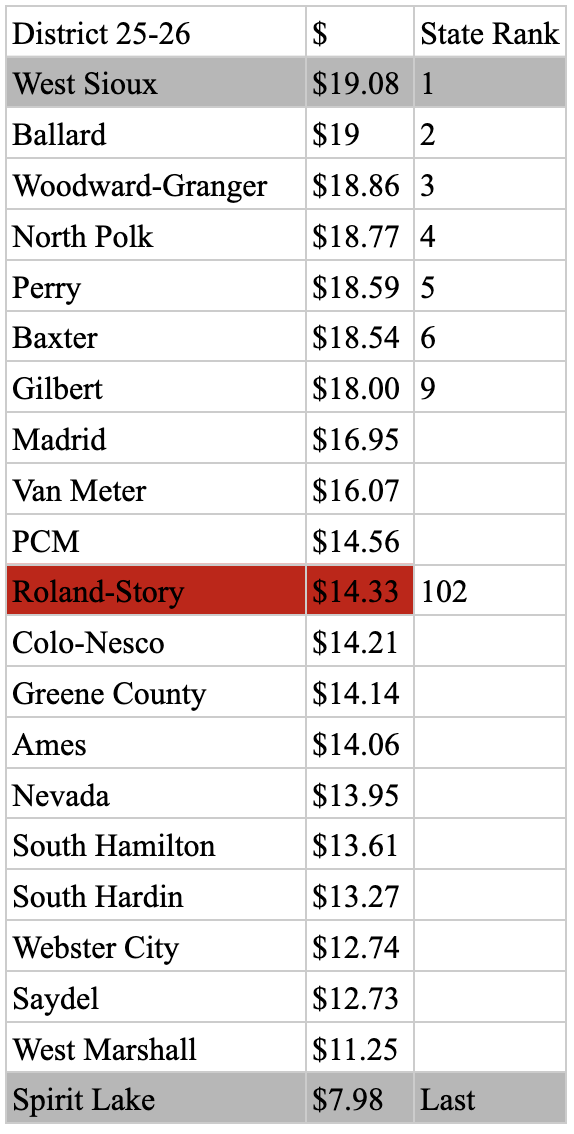
DISTRICT INFORMATION
How can I learn more about these projects and the bond vote?
Visit the district’s facility projects and bond information website at: https://www.rolandstory.school/page/facility-projects-and-bond-information
Attend one of the remaining Community Conversations meetings:
Thursday, June 11th, 2026 at 6:00 pm - Middle School Library (Roland)
Sunday, June 14th, 2026 at 6:00 pm - High School Library (Story City)
Thursday, June 25th, 2026 at 6:00 pm - Middle School Library (Roland)
Sunday, June 28th, 2026 at 6:00 pm - High School Library (Story City)
Why don’t we just pay teachers and staff more instead of spending so much on buildings and infrastructure?
State funding to Iowa school districts is tightly regulated. They aren't choosing to withhold raises or compensation increases in lieu of building projects; the state funding system legally prevents Iowa districts from being flexible while balancing all of the different funding buckets that build a district’s budget.
The vast majority of each district's budget is strictly determined by a rigid, state-mandated dollar amount per student. If a district's enrollment is declining, their budget automatically shrinks.
To make matters more difficult, much of the remaining state money comes in the form of categorical funds that are legally earmarked for very specific uses like technology or specialized programming and cannot be legally diverted to teacher payroll.
Here is further breakdowns:
Iowa uses a "cost-per-pupil" formula to determine baseline funding. If a school has 1,000 students, they get approximately $8,000 per student from the state. If they lose 50 students next year due to declining rural enrollment or open enrollment to neighboring districts, their funding drops sharply, but their fixed costs of heating the building, maintaining buses stay exactly the same.
The "buckets of money" or categorical funds. Think of school funding like buckets. A district might have $100,000 sitting in a "Bucket" labeled Title I Funds. By law, they cannot use that money to give a general education teacher a raise or increase the hourly wages for a Special Education Associate. A district may have a “Bucket” filled with money taken from taxpayers from the PPEL levy. By law, they can use that money on building maintenance efforts and technology, but that money cannot be used to pay teachers or staff.
It is illegal to move money between these strict budgetary buckets, which is why districts have to maneuver separate funds available to them when balancing compensation for staff and building projects. See Funding Buckets Graphic.
Most districts operate on highly structured salary schedules negotiated through collective bargaining. Every single dollar is mapped out 2-3 years in advance based on a teacher's years of experience and college credits. There is no "slush fund" or discretionary pool of money to hand out merit raises or adjust to inflation on a whim.
What are Roland-Story's enrollment trends?
District certified enrollment (students in district) remains stable with certified enrollment staying around 1,000 students for the past 5 years. The number of students who enroll into Roland-Story continues to be an average of about 135 students per year for the past five years. This open enrollment is in comparison to about 55 students who open enroll out, giving us a net gain of about 80 students. Those additional students are adding a substantial amount to the district's general funds, and complete what is called served enrollment (total students served in the district). However, it is important to note that these funds are not permitted to be used towards capital projects.
How much do other districts bond this much?
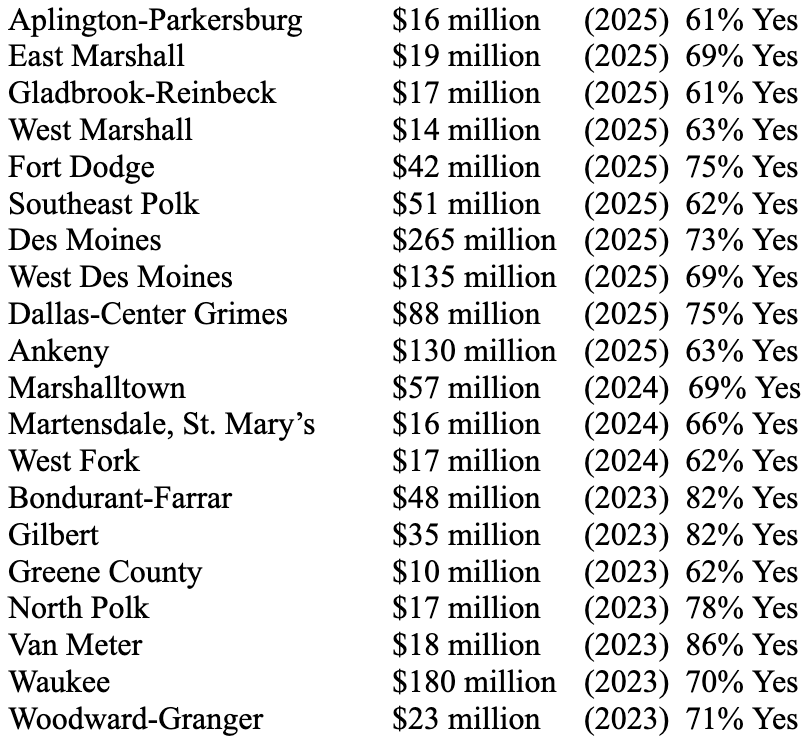
General Obligation (G.O.) Bonding is a very common approach that districts take when needing infrastructure and facilities upgrades. The number of bonds issued yearly by Iowa districts varies by year. Below is a chart of the G.O. bonds that have been passed in the last 3 years.
School G.O. bond referendums passed in Central Iowa in the past 10 years: